
Socioeconomic Differences in Young Adults’ Future Outlook and Associations with Perceived Fairness and Social Capital in South Korea
Abstract
The outlook of young adults on the future is closely tied to major life-course decisions, including marriage and childbirth, and it also influences their attitudes toward public policy, making it significant at the individual and societal levels. Understanding why some young adults maintain a more positive outlook for the future than others, even under similar socioeconomic conditions, remains an important academic and policy question. Using data from the 2021 and 2022 Korean Happiness Survey conducted by the National Assembly Futures Institute, this study examined 6,286 individuals aged 19-34 to determine how perceived fairness and social capital are associated with future outlook, and how these associations vary across socioeconomic groups. The results showed that the perceived fairness is significantly correlated with young adults’ future expectations. Among the lower-income groups, social networks and generalized trust were positively associated with an optimistic view of the near future. In contrast, among the higher-income groups, generalized trust and social participation—such as donation and volunteering—showed stronger associations. These findings suggest that the subjective perceptions of fairness are linked to young adults’ assessments of the present and their expectations for the future, and that different components of social capital shape future outlooks differently across income groups.
초록
청년세대의 미래전망은 결혼·출산과 같은 생애경로 결정뿐 아니라 정책 태도 형성과도 밀접하게 연관된다는 점에서 개인적·사회적 차원 모두에서 중요한 의미를 갖는다. 특히 동일한 사회경제적 조건에 처해 있음에도 일부 청년들이 미래를 다르게 인식하는 메커니즘을 규명하는 것은 학술적·정책적으로 중요한 과제이다. 본 연구는 국회 미래연구원이 수행한 2021·2022년 「한국인의 행복조사」 자료를 활용하여 19~34세 청년 6,286명을 대상으로 공정성 인식과 사회자본이 미래전망과 어떠한 관련성을 보이는지, 그리고 그 양상이 계층에 따라 어떻게 다른지를 분석하였다. 분석결과, 공정성 인식은 미래전망과 통계적으로 유의한 상관관계를 보였다. 또한, 소득이 낮은 집단에서는 사회적 연결망과 일반적 신뢰가 긍정적 미래전망과 연관됐지만, 소득이 높은 집단에서는 일반적 신뢰와 더불어 기부·자원봉사 등 사회참여 수준이 미래전망과 관련성을 나타냈다. 이러한 결과는 청년의 공정성에 관한 주관적 인식이 미래전망과도 관련이 있음을 보여준다. 더 나아가, 사회자본의 구성 요소가 계층별로 다르게 작동하는 상호작용 속에서 청년의 미래전망이 형성됨을 시사한다.
Keywords:
Future Prospects, Young Adults, Perception of Fairness, Social Capital키워드:
미래전망, 청년, 공정성 인식, 사회적 연결망, 신뢰, 호혜적 사회자본1. Introduction
What factors shape young adults’ outlook on the future? In particular, among those who do not come from advantaged socioeconomic backgrounds, what makes some of them to maintain an optimistic view of their future? Understanding these dynamics is essential for identifying the conditions that foster hope among youth in uncertain times. Particularly, the context of South Korea is valuable, as Korea’s fertility rate, lowest in the world, reflects prevalence of the bleak outlook on future among South Korean young adults. How individuals perceive their future prospects plays a crucial role in shaping key life decisions, including those about family formation (Vignoli, Bazzani, Guetto, Minello, & Pirani, 2020; Kwan & Choi, 2023). While early studieshavelargely focused on economic instability and structural barrierssuch as unstable employment, housing insecurity, and educational costs, aburgeoningliterature has turned attention to the importance of subjective perceptions (An, Lee, & Woo, 2022; Kwag, Baek, & Kang, 2024).
Besides decisions on family formation, much more decisionsin life planning are not only shaped by immediate material circumstances, but also by long-term subjective expectations about the future. These expectations reflect deeper social sentiments, such as hope or despair. In South Korea, where social discourse is increasingly dominated by concerns over inequality and perceived immobility, it becomes even more critical to understand how young people interpret their chances for a better life.
Public discourse in South Korea has frequently featured terms such as the “gold spoon vs. dirt spoon” or the “N-Po generation (a younger generation—mostly people in their 20s and 30s—who feel forced to give up (Po)multiple (N) important life goals),” reflecting a perceived erosion of fairness in socioeconomic mobility. These discourses are not merely rhetorical; they are rooted in lived experiences of intense competition, job market precarity, and unaffordable housing (Lee, Shin, & Yoon, 2022). The COVID-19 pandemic further exacerbated these pressures, disproportionately impacting younger generations and deepening feelings of frustration and social disconnection. As previous studies have noted, perceived fairness is a strong predictor of life satisfaction (Lee & Park, 2021), yet few studies have examined how it intersects with young adults’ future expectations.
Future life expectations also tend to vary according to the strength of social networks, trust, and engagement in donation and volunteer activities. Furthermore, it is notable that the level of social bonding, trust among young adults is not uniform across the socioeconomic status, suggesting the intertwined dynamics between socio-economic status and future prospect.
Recognizing these dynamics, the present study aims to examine how perceived fairness and the strength of social capital relates to young adults’ future prospect, and how this relationship differs by one’s status. Based on prior literature on social capital (Hwang, 2021), we selected three representative variables: social networks, trust, and reciprocity. This perspective allows us to move beyond material conditions and examine how social attitudes and behaviors shape the ways in which young people envision their futures. In order to provide empirical evidence, this study employs the Korean’s happiness survey. Two waves from the datasets are combined, and 6,286 South Korean young adults, aged between 19 and 34 years old are analyzed.
This study contributes to the existing literature in at least three significant ways.
First, this study contributes to the literature by identifying the determinants of young adults’ future prospects. While prior research has primarily focused on current levels of life satisfaction or subjective well-being, this study shifts the analytical focus to how youth perceive their future, a dimension that is increasingly recognized as central to understanding long-term life outcomes. Perceptions of the future play a significant role in shaping not only life-course decisions such as family formation and career planning, but also political orientations and social behaviors.
In particular, this study builds on and extends the findings of Kwan and Choi (2023), who provided that future prospects are associated with fertility intentions. This study draws attention to an earlier part of correlation chain: examining what shapes future prospects. Although there is growing consensus on the importance of future prospect, empirical research remains limited. This study addresses the gap by offering a systematic analysis of both attitudinal (e.g., fairness, trust) and behavioral (e.g., social networks, donation/volunteer activities) factors on young adults’ expectations for their future.
Second, this study examines a range of social attitudes and behaviors which are relevant to young adults’ future, including perceived fairness, social networks, trust, and donation/volunteering. Among these, social networks, trust, and donation/volunteering have been reviewed in prior research on social capital (Hwang, 2021; Hwang, 2024). Building on this foundation, the present study introduces fairness as an additional dimension and categorizes these elements into attitudinal and behavioral components. We then analyze them collectively to explore their implications for individuals’ future outlooks. In particular, donation and volunteer activities are considered as meaningful factors in this study.
While some scholars have attempted to conceptualize such behaviors in terms of altruistic capitalor reciprocal norms (Ashraf & Bandiera, 2017; Hwang, 2021), few studies have examined how donation and volunteer activities are linked to future prospect. By drawing attention to previously overlooked behavioral dimensions, this study expands existing perspectives and offers a more nuanced understanding of how social embeddedness may shape youth perceptions of the future.
Third, this study underscores the heterogeneity in how social attitudes and behaviors relate to future prospect across different income groups. The findings reveal that the factors shaping young adults’ future expectations vary significantly depending on household income level. For instance, trust and social networks appears particularly pronounced among those in lower-income groups, while donation and volunteer activities are beneficial among those in higher-income groups. This suggests that the role of social attitudes and behaviors in shaping future prospect is not uniform, but context-dependent, reflecting the differing resources and constraints faced by youth from varying economic backgrounds.
This study is constructed as follows: existing literature is reviewed in the following section. Data, analytical samples and measurements are introduced, followed by main findings. Interpretation and implications will be discussed in the final section.
2. Theoretical framework
1) Future prospects of the young adults
A growing body of literature underscores the importance of psychological attitudes—such as self-efficacy and hope—in shaping young adults’ subjective well-being and major life decisions. For example, self-efficacy, particularly the perceived probability of success in education and employment, has been shown to have a significant positive effect on subjective well-being (Trzcinski & Holst, 2008).
Young adults’ future prospects—reflected in their anticipated life satisfaction five years ahead—are often more optimistic than those of older adults, even after controlling for variables such as age, sex, education, income, and self-rated health (Lang, Weiss, Gerstorf, & Wagner, 2013). This future-oriented outlook is conceptually linked to optimism and resilience. Optimism, in particular, has been shown to be positively associated with subjective well-being under adversity, engagement in adaptive coping strategies, and better physical health (Carver, Scheier, & Segerstrom, 2010). One important benefit of optimism is its role in enhancing resilience: for example, college students with higher optimism showed better psychological outcomes following the 9/11 terrorist attacks, retaining emotional resources and coping more effectively (Fredrickson, Tugade, Waugh, & Larkin, 2003).
In the Korean context, future expectations are a critical issue among young adults. A study of college students found that those with negative outlooks tended to evaluate their present lives more critically, perceived their goal attainment as low, and reported lower levels of self-efficacy and life satisfaction across various domains (Oh, 2008). More broadly, positive expectations for the future have been consistently linked to better quality of life (Tavakoly Sany, Aman, Jangi, Lael-Monfared, Tehrani, & Jafari, 2023).
2) Perception of fairness and social capital
At the structural level, Korea’s intergenerational dynamics—exacerbated by rapid population aging—also impact youth outlook. According to National Transfer Accounts, resource transfers from the working-age population to the elderly are increasing. Big data analysis highlights job competition and the pension system as key drivers of generational conflict (Hwang, 2022). Meanwhile, labor market indicators show persistent difficulties for men in their 20s, in contrast to the relatively stable employment of older age groups.
Recent research by Kwan and Choi (2023) demonstrated that young adults’ expectations regarding intergenerational mobility are closely tied to their fertility intentions, highlighting how future prospects shape critical life decisions. This study focuses on a prior stage in that pathway: the determinants of such future prospects, particularly as young adults navigate the early stages of their work and family lives in an increasingly uncertain environment. Future-oriented attitudes also influence emotional responses and real-world choices. Chin, Han, and Noh (2019) found that latent profiles of perceived social justice, class reproduction, and self-prospects were strongly associated with marriage and fertility attitudes. Similarly, Kim (2022) emphasized the importance of “dream capital”—a conceptual extension of Bourdieu’s forms of capital encompassing imagination, hope, optimism, and resilience—as a critical resource influencing young adults’ life decisions.
Social capital—particularly trust, norms of reciprocity, and social networks—is another critical factor influencing future prospects. Putnam (2000) argued that social connections and shared norms enhance individual and collective outcomes. Empirical studies confirm that social capital supports educational and career aspirations (Boat, Miranda, & Syvertsen, 2022; Wittner & Kauffeld, 2023), labor market success (Letnar & Širok, 2025; Behtoui, 2013), civic engagement (Duke, Skay, Pettingell, & Borowsky, 2008), and physical and mental health (McPherson, Kerr, Morgan, McGee, Cheater, McLean, & Egan, J., 2013).
Hwang (2021) also highlights the importance of “reciprocal norms”—implicit social standards that promote mutual respect and fairness. Indicators such as organizational membership and active participation are positively correlated with valuing others, suggesting that a culture of reciprocity may reinforce optimism and a sense of fairness. Ashraf and Bandiera (2017) argue that strengthening perceived returns to altruistic behavior can foster “altruistic capital,” further enhancing individual and societal well-being.
3) Disparities by Socio-Economic Background
Subjective socioeconomic status (SES) is a major determinant of how Korean youth evaluate the future. Hwang (2023) found that subjective SES, shaped by age, co-residence with parents, marital status, employment, and location, significantly influences perceptions of justice. A decline in perceived SES tends to strengthen the belief that society is unjust—especially among those who have experienced downward mobility. These individuals are more likely to encounter multifaceted inequalities in marriage, employment, and housing, and to feel that their efforts are not fairly rewarded.
Access to “dream capital” also varies by income level. According to Kim, Chung, Cho, and Nam (2023), non-poor youth are more likely to receive emotional and aspirational support from family and social ties, while economically disadvantaged youth often struggle to build such capital due to material hardship and a lack of supportive environments.
Perceptions of social mobility and fairness are not always aligned with objective measures of inequality and vary significantly by socioeconomic background. Aassve, Mencarini, and Sironi (2004) demonstrated that subjective perceptions of mobility affect demand for redistribution. Ugur (2021) found that incorporating such perceptions in empirical models mitigates the negative effects of inequality, particularly among low- and high-income groups.
Socioeconomic background also interacts with race/ethnicity in shaping aspirations. In the U.S. context, Howard, Carlstrom, Katz, Chew, Ray, Laine, and Caulum (2011) showed that higher-income youth across racial groups aspire to more prestigious careers than their lower-income peers. In Korea, Lee (2018) found that subjective SES strongly influences perceptions of justice—those who see themselves as lower-status are more likely to feel that their efforts are not rewarded fairly. Regional and gender differences further complicate the picture; for instance, young men in metropolitan areas often perceive educational opportunities as less fair but view job opportunities more positively, while women tend to hold the opposite view (Lee & Park, 2021).
This study focuses on the effects of perceived fairness, social capital (such as trust, networks, and altruistic behavior) on youth’s future prospects—while paying particular attention to how these relationships differ across socioeconomic groups. Prior studies suggest that youth volunteering is associated with better educational and labor market outcomes in adulthood (Kim & Morgül, 2017). Volunteering may enhance employability and earnings, thereby improving future outlooks. Religious participation, meanwhile, fosters social capital and future orientation, especially among Millennials (Fox, Muddiman, Hampton, Kolpinskaya, & Evans, 2021), and can help mitigate intergenerational inequalities. However, few studies have examined how these social and psychological resources interact with income-based disparities in shaping youth expectations. This study seeks to fill that gap.
3. Measurement
1) Data and sample
This study employs two waves from 2021 and 2022 of the Korean’s Happiness Survey (Heo, 2021; Heo, 2022). The Korean’s happiness survey is cross-sectional dataset, conducted by National Assembly Future Institute. The final analytical sample is 6,286 South Korean young adults aged between 19-34. South Korea lacks a consistent age standard to define young adults, unlike countries such as Germany, where the highest law sets a unified age standard. (Jang, Choi, Kim, Ha, Yoo, & Cho, 2018). For example,local governments define ‘young adults’ differently depending on their policy goals, with age ranges spanning from 18 to 49 (Ko, 2023). This study defines young adults to be between 19 and 34 years old based on the Framework Act on Youth. Restricting the analytical sample to those who have no missing values in variables of main interest, the final sample size is 2,589 from the 2021 wave of the survey and 3,697 from the 2022 wave. Among the final sample, sex and age are balanced, as men comprise 52%. Among the analytical sample, those who are currently married consists of 18% which reflects a recent trend of the delayed marriage in South Korea. In 2022, the age for first marriage among men is 33.7 years old and 31.3 years old among women (Statistics Korea, 2023).
To examine different patterns of future prospect across household income group, this study divides respondents into three household income groups: the lowest 25%, the highest 25%, and a middle group. This classification allows us to explore how social and psychological resources differ across income levels and how such differences may contribute to unequal outlooks on the future.
2) Measurement
Main outcome variable is future prospect for the life satisfaction: “How do you predict that you will be satisfied with your life 5 years later?”. Respondents are asked to answer by 11 scales from 0, very unsatisfied through 5 more or less to 10 very satisfied. The mean of future prospect for the life satisfaction is 7 (Table 1). Compared to the level of life satisfaction in present (mean=6.5), overall future prospect is reported to be more positive on average. The skewness of the future prospect, -0.61 also supports this.

Sample characteristics(n=6,286)
The independent variables of major interest are perception of fairness, social network, trust, and donation/volunteering. The perceived social fairness, is measured by an indexed variable combining questions regarding several realms. Respondents are asked to answer to a question “What is your evaluation on equality of each realm in our society: education opportunity, employment opportunity, enactment of law, income and asset, power, and gender” by five scales from 0 very unfair to 5 very fair. The perceived social fairness is constructed using the mean of these six answers. Table 1 reports that the perceived fairness among the respondents are 3.04, with a normal distribution.
Social network is measured by an indexed variable constructed using three questions: if there’s someone who can lend money when you suddenly need a large amount; if there’s someone who can help when you are in pain and difficult to move; if there’s someone you can talk when you’re feeling depressed or stressed. Answers from each question is recoded as 0 if a respondent has no one to ask help, 1 if a respondent has family or kinship to ask help, and 2 if a respondent has social bond besides family or kinship to ask help including friends, acquittances, social institutions or even paid service. The mean of the answers from three occasions are used to proxy social network. The social network is reported to be 1.15 in Table 1.
General trust is measured with five scales from 1, cannot trust at all to 5, can trust. The mean of trust level is 3.47 among the analysis sample as in Table 1.
Lastly, engagement in donation or volunteering is measured by an experience of either regular or irregular donation and volunteer community service during the last one year. It is recoded to be 1 if a respondent has never participated in donation or community service during last one year, 2 if the one has ever participated on an irregular basis, and 3 if the one participates on a regular basis. The means of engagement indonation and community service is 1.19 asin Table 1.
To examine how the perception of fairness, social network, trust and engagement in donation/volunteering relates to the future prospects among the young adults, this study implements hierarchical multiple regression. The predictor variables are added to a regression model in steps. Sociodemographic controls include sex, age, marital status, household income, education level and wave fixed effect.
4. Findings
How are social attitudes and behaviors related to the future prospect? To examine how different levels of fairness, social network, trust, and donation/volunteer are associated with future prospect, hierarchical multiple regression is implemented and its results are presented in Table 2. The dependent variable is the reported level of respondent’s future optimism. Key predictors are perceived fairness, social networks, donation/volunteering behavior, and trust, along with sociodemographic controls.
Regression result
Model 1 includes only perceived fairness as the main predictor and shows a strong positive association (β = 0.16, p < .001). This suggests that individuals who perceive society as more fair are more likely to hold positive expectations about their future. The effect of perceived fairness remains robustand significant across all four models,albeit slight decrease with the additional variables.
Model 2 adds social networkvariable, which are also significantly associated with future prospects (β = 0.24, p < .01). This association remains significant even after controlling for other variables in Models 3 and 4, confirming the existing literature (Putnam, 2000; Boat et al., 2022; Wittner & Kauffeld, 2023). The result suggests the importance of social connectedness for fostering a positive prospect among young adults.
Model 3 introduces participation in donation and volunteer activities. The results show a positive relationship (β = 0.14, p < .001),supporting the prior study which suggested that altruistic behavior improves individual and collective outcomes (Ashraf & Bandiera, 2017). In the final model (Model 4), trust is added and shows a strong and statistically significant relationship (β = 0.19, p < .001), confirming the positive role of trust.
Among control variables, higher education level, higher household income, and being married are all positively associated with future prospects. Conversely, being male and older age are associated with lower levels of future optimism.
Then, how these relationships differ by different income groups? We first examined whether young adults’ future outlook varies by household income. As shown in Figure 1, the mean future outlook increases steadily across income groups: 6.81 among the low-income group, 7.04 among the middle-income group, and 7.14 among the high-income group. Although the differences are modest, the upward gradient is clear, indicating that young adults from higher-income households tend to hold a more optimistic view of their near future.
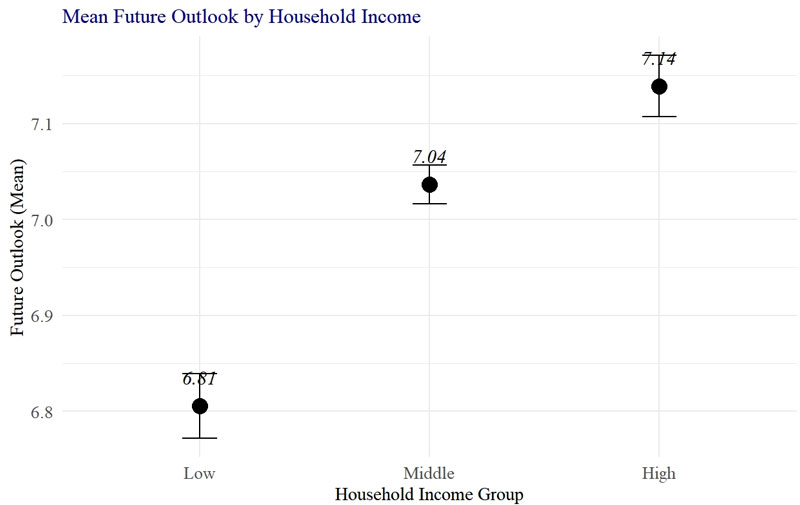
Future outlook by income group
Then, how do perceived fairness, social network, trust, and donation/volunteer are associated with future prospect across different income groups?
Table 3 presents regression results by household income subgroups, revealing distinct patterns in how social attitudes and behaviors relate to young adults’ future prospects.
Subgroup analysis by household income
In Lower-income Group, perceived fairness, trust, and education are positively associated with future outlook. Notably, social network size shows a marginally significant effect, suggesting that interpersonal connections may play a relatively greater role for youth with fewer economic resources.
In contrast, in Higher-income Group, participation in donation and volunteer activities stands out as a strong and significant predictor. This suggests that for more affluent youth, altruistic engagement may be more associated with their sense of future positiveness, potentially reflecting internalized values or civic-minded orientations. Perceived fairness and trust also remain significant in this group.
In Middle-income Group, perceived fairness and trust retain positive associations with future outlook, but neither network nor donation/volunteer shows a significant effect, implying a weaker role of social behavioral factors for this group.
Taken together, these results underscore the different effects of social behaviors across income groups: network-based social embeddedness appears more critical for lower-income youth, while altruistic behavior such as donation and volunteer is more closely tied to future outlooks among higher-income youth. This suggests that while relational and attitudinal factors matter across youth with different backgrounds, the mechanisms through which social context influences future perception may vary.
5. Discussions
As South Korea continues to experience historically low fertility rates, the need to understand the perceptions, experiences, and aspirations of young adults has become more urgent than ever. In this context, the concept of future prospects—how young people view their future life—offers valuable insight into how individuals engage with broader social and economic structures. This study provides empirical evidence on how the perception of fairness, trust, social bonding, and reciprocal norms shape the future outlook. More importantly, one of the key findings is that this effect varies depending on one’s status.
The findings confirm that future prospectsare influenced by the perception of fairness. generalized trust, social bonding, and donation/volunteering. The more fairly an individual perceives their society to be, the more positively they tend to view their future. Also, the individuals with higher level of trust, networks and reciprocal norms are more likely to maintain a positive outlook on their future.
More notably, these effects differ across the household income level. Specifically, Young adults from lower-income families are more likely to envision a positive future when they have strong social networks and a high level of trust. In contrast, higher-income youth are more influenced by engagement in donating and volunteering, along with trust. These results suggest that for economically disadvantaged youth, social bonding and trust are key to shaping their future outlook, whereas for their more advantaged peers, fostering norms of reciprocity and trust appears to be more influential.
Why might network ties and trust be especially influential for low-income group? One possible explanation lies in the limited availability of formal institutional support. For economically disadvantaged individuals, informal networks often become vital substitutes. A young adult from a low-income household who is part of a church group, student organization, or neighborhood community may gain not only emotional support but also access to essential resources—such as information on scholarships, job opportunities, or housing. These experiences can gradually foster a sense of societal trust and belonging, shaping a more positive outlook on the future.
In contrast, higher-income youth tend to rely more on engagement in donation and voluntary community service. These activities not only reflect a sense of altruism, pro-sociality, reciprocity and values, thereby enriching private utility (Ashraf & Bandiera, 2017), but also reinforce perceptions of shared purpose. For economically advantaged individuals, participating in giving and volunteering may affirm their belief that they are part of a cooperative and just society, thereby enhancing their future expectations.
As a follow-up study, it would be valuable to examine gender differences in determinants of future outlooks. Following the reboot of feminism, many young women have become more active in university communities—such as courses, clubs, and peer groups—to build networks and engage with feminist ideas (Jung, 2025). These experiences reflect their growing awareness of gender inequality and interest in fairness issues in daily life (Jung, 2024). In this context, gender may shape how young people form social ties and perceive their future, suggesting the need for gender-sensitive research on future expectations.
This study sheds light on the distinct ways in which perceived fairness, social network, trust and donation/volunteer activities shape youth’s future prospect, depending on their socioeconomic background. For young adults from the lower-income group, close social bonds, trust and perceived fairness play a critical role in fostering hope and possibility. In contrast, for those from the higher-income group, engagement in donation and volunteer activities, alongside trust and perception of fairness is more strongly linked to positive future expectations. These findings suggest that building inclusive pathways to trust, connection, and civic participation can help ensure that all young people have the social foundation to envision meaningful futures. Although this study focuses on young adults in South Korea, the findings may have broader relevance to other contexts experiencing youth precarity and rising inequality.
Acknowledgments
This work was supported by the Ministry of Education of the Republic of Korea and the National Research Foundation of Korea (NRF-2023S1A5B5A17087630).
This work is developed from a manuscript awarded at the 1st Happiness Research Paper Contest by the National Assembly Futures Institute.
References
-
Aassve, A., Mencarini, L., & Sironi, M. (2015). Institutional change, happiness, and fertility. European Sociological Review, 31(6), 749-765.
[https://doi.org/10.1093/esr/jcv073]

-
Alesina, A., Di Tella, R., & MacCulloch, R. (2004). Inequality and happiness: are Europeans and Americans different?. Journal of Public Economics, 88, 2009-2042.
[https://doi.org/10.1016/j.jpubeco.2003.07.006]
-
An, D., Lee, S.-L., & Woo, H. (2022). Marriage intention among korean young adults: trends and influencing factors. International Journal of Environmental Research and Public Health, 19(14), 8557.
[https://doi.org/10.3390/ijerph19148557]
-
Ashraf, N., & Bandiera, O. (2017). Altruistic capital. American Economic Review, 107(5), 70-75.
[https://doi.org/10.1257/aer.p20171097]
-
Boat, A. A., Miranda, A., & Syvertsen, A. K. (2022). Enhancing education and career pathways through peer and near-peer social capital. Journal of Youth and Adolescence, 51, 1287-1304.
[https://doi.org/10.1007/s10964-021-01540-x]
-
Carver, C. S., Scheier, M. F., & Segerstrom, S. C. (2010). Optimism. Clinical Psychology Review, 30(7), 879-889.
[https://doi.org/10.1016/j.cpr.2010.01.006]
-
Chin, M., Han, J., & Noh, S. (2019). An Association Between Latent Profiles of Marriage and Childbirth Attitudes and Individual Perceptions on Korean Society and Own Future Prospect among Young Adults. Family and Culture, 31(1), 166-188.
[https://doi.org/10.21478/family.31.1.201903.007]
-
Duke, N. N., Skay, C. L., Pettingell, S. L., & Borowsky, I. W. (2008). From adolescent connections to social capital: predictors of civic engagement in young adulthood. Journal of Adolescent Health, 44(2), 161-168.
[https://doi.org/10.1016/j.jadohealth.2008.07.007]
-
Fox, S., Muddiman, E., Hampton, J., Kolpinskaya, E., & Evans, C. (2021). Capitalising on faith? An intergenerational study of social and religious capital among Baby Boomers and Millennials in Britain. Sociological Review, 69(4), 862-880.
[https://doi.org/10.1177/0038026120946679]
-
Fredrickson, B. L., Tugade, M. M., Waugh, C. E., & Larkin, G. R. (2003). What Good Are Positive Emotions in Crises? A Prospective Study of Resilience and Emotions Following the Terrorist Attacks on the United States on September 11th, 2001. Journal of Personality and Social Psychology, 84(2), 365-376.
[https://doi.org/10.1037/0022-3514.84.2.365]
-
Helliwell, J. F., Huang, H., & Wang, S. (2014). Social Capital and Well-Being in Times of Crisis. Journal of Happiness Studies, 15(1), 145-162.
[https://doi.org/10.1007/s10902-013-9441-z]
-
Heo, J. H. (2021). Korean’s Happiness Survey[data]. National Assembly Futures Institute [implemented]. Korea Social Science Data Archive (KOSSDA) [provided], Aug 17, 2022.
[https://doi.org/10.22687/KOSSDA-A1-2021-0003-V2.0]
-
Heo, J. H. (2022). Korean’s Happiness Survey[data]. National Assembly Futures Institute [implemented]. Korea Social Science Data Archive (KOSSDA) [provided], July 25, 2024.
[https://doi.org/10.22687/KOSSDA-A1-2022-0060-V2]
-
Howard, K. A., Carlstrom, A. H., Katz, A. D., Chew, A. Y., Ray, G. C., Laine, L., & Caulum, D. (2011). Career aspirations of youth: Untangling race/ethnicity, SES, and gender. Journal of Vocational Behavior, 79, 98-109.
[https://doi.org/10.1016/j.jvb.2010.12.002]
-
Hwang, S. J. (2024). Subjective inequality in South Korea: Perception, belief, and discontent. Research in Social Stratification and Mobility, 89, 100875.
[https://doi.org/10.1016/j.rssm.2023.100875]
- Hwang, S. K. (2021). A Study on the Characteristics and Formation of Social Capital in Korea. KDI Research Monograph, 4.
-
Hwang, S.-J. (2022). Population Aging and Generational Conflict: Intergenerational Equity over Resource Allocation. Journal of Social Science, 33(2), 149-172.
[https://doi.org/10.16881/jss.2022.04.33.2.149]
-
Hwang, S.-J. (2023). Analysis of trends and determinants of perceived economic inequality, 2016~2020. The Korean Journal of Sociology, 57(3), 1-32.
[https://doi.org/10.21562/kjs.2023.08.57.3.1]
- Jang, M. S., Choi, H. Y., Kim, K., Ha, H., Yoo, M. S., & Cho, S. (2018). A Study on Securing Age Standards on Legislations and the Connectivity with Policy. https://www.klri.re.kr/repository/handle/2017.oak/5642
-
Jung, G., & Moon, M. (2025). “Feminism is like a light to me”: The collective process of feminist awakening among young female college students in South Korea. Asian Journal of Social Science, 53(1), 100177.
[https://doi.org/10.1016/j.ajss.2024.10.002]
-
Jung, G., Liang, Y., & Lee, H. (2024, November). “I feel free and comfortable”: The Escape the Corset Movement in South Korea and the question of women’s agency. In Women’s Studies International Forum (Vol. 107, p. 102973). Pergamon.
[https://doi.org/10.1016/j.wsif.2024.102973]
-
Kim, J., & Morgül, K. (2017). Long-term consequences of youth volunteering: Voluntary versus involuntary service. Social Science Research, 67, 160-175.
[https://doi.org/10.1016/j.ssresearch.2017.05.002]
- Kim, J., Chung, I., Cho, Y., & Nam, M. (2023). What and how do young people in Korean society dream?: Focusing on the experience of preparing dreams of poor and non-poor young people. Studies on Korean Youth, 34(3), 67-102.
-
Kim, S. (2022). A Socio-psychological Approach to Low Fertility: Who Can’t, and Why Can’t They Dream of Marriage and Childbearing? Survey Research, 23(2), 1-33. https://kiss.kstudy.com/thesis/thesis-view.asp?key=3948157
[https://doi.org/10.20997/SR.23.2.1]
- Ko, Y. (2023, February 16). Youth Age over 40s in 48 Local governments in Korea. Chosunilbo. https://www.chosun.com/national/national_general/2023/02/16/RSNT34PHCZHZVC3IRQUWPCLAW4/
-
Kohler, U., Karlson, K. B., & Holm, A. (2011). Comparing coefficients of nested nonlinear probability models. Stata Journal, 11(3), 420-438.
[https://doi.org/10.1177/1536867X1101100306]
-
Kwag, H., Baek, S., & Kang, M. (2024). Impact of social trust on young adults’ childbearing intention: why does South Korea show ultra-low fertility?. International Journal of Urban Sciences, 28(4), 585-610.
[https://doi.org/10.1080/12265934.2024.2320905]
-
Kwan, D. E., & Choi, S. (2023). Examining the Link Between Future Prospects and Intentions to Have Children. Journal of Policy Studies, 38(1), 59-70.
[https://doi.org/10.52372/jps38105]
-
Lang, F., Weiss, D., Gerstorf, D., & Wagner, G. (2013). Forecasting life satisfaction across adulthood: benefits of seeing a dark future?. Psychology and Aging, 28(1), 249-261.
[https://doi.org/10.1037/a0030797]
-
Lee, H.-J. (2018). An analysis on the change in the subjective socioeconomic status of the youth and its effect on perception toward justice. Korean Journal of Sociology, 52(3), 119-164.
[https://doi.org/10.21562/kjs.2018.08.52.3.119]
-
Lee, H.-J., & Park, S. (2021). A study on fragmentation of young people’s perceptions on the fairness of opportunity: a geographical and gender perspective. Korea Journal of Population Studies, 44(3), 71-99.
[https://doi.org/10.31693/KJPS.2021.09.44.3.71]
-
Lee, N., & Im, T. (2021). The impact of socio-economic position on perceived oppression: Using social support as a mediator. Korean Journal of Policy Studies, 36(2), 1-19.
[https://doi.org/10.52372/kjps36201]
- Lee, S., Shin, Y., & Yoon, M.-S. (2022). The effects of relative deprivation of youth on suicide: the serial mediation effect of prospects and social isolation. Health and Social Welfare Review, 42(2), 369-389.
-
Letnar, M., & Širok, K. (2025). The role of social capital in employability models: a systematic review and suggestions for future research. Sustainability, 17(5).
[https://doi.org/10.3390/su17051782]
-
McPherson, K. E., Kerr, S., Morgan, A., McGee, E., Cheater, F. M., McLean, J., & Egan, J. (2013). The association between family and community social capital and health risk behaviours in young people: an integrative review. BMC Public Health, 13, 1-13.
[https://doi.org/10.1186/1471-2458-13-971]
- Oh, H. S. (2008). A study of the relationships between the employment prospects, life aims and life satisfaction of university students. Korean Journal of Psychological and Social Issues, 14(4), 19-37.
-
Putnam, R. D. (2000). Bowling Alone: The Collapse and Revival of American Community. New York: Simon and Schuster.
[https://doi.org/10.1145/358916.361990]
- Statistics Korea. (2023). Marriage and Divorce Statistics in 2022. https://kostat.go.kr/board.es?mid=a20108110000&bid=11774&act=view&list_no=424779
-
Tavakoly Sany, S. B., Aman, N., Jangi, F., Lael-Monfared, E., Tehrani, H., & Jafari, A. (2023). Quality of life and life satisfaction among university students: Exploring, subjective norms, general health, optimism, and attitude as potential mediators. Journal of American College Health, 71(4), 1045-1052.
[https://doi.org/10.1080/07448481.2021.1920597]
-
Trzcinski, E., & Holst, E. (2008). Subjective well-being among young people in transition to adulthood. Social Indicators Research, 87(1), 83-109.
[https://doi.org/10.1007/s11205-007-9160-0]
-
Vignoli, D., Bazzani, G., Guetto, R., Minello, A., & Pirani, E. (2020). Uncertainty and narratives of the future: a theoretical framework for contemporary fertility. Analyzing Contemporary Fertility, 51, 25-47.
[https://doi.org/10.1007/978-3-030-48519-1_3]
-
Wittner, B., & Kauffeld, S. (2023). Social capital and career planning amongst first generation and non-first generation high school and college students in Germany: a social network analysis approach. International Journal for Educational and Vocational Guidance, 23(2), 295.
[https://doi.org/10.1007/s10775-021-09513-z]